
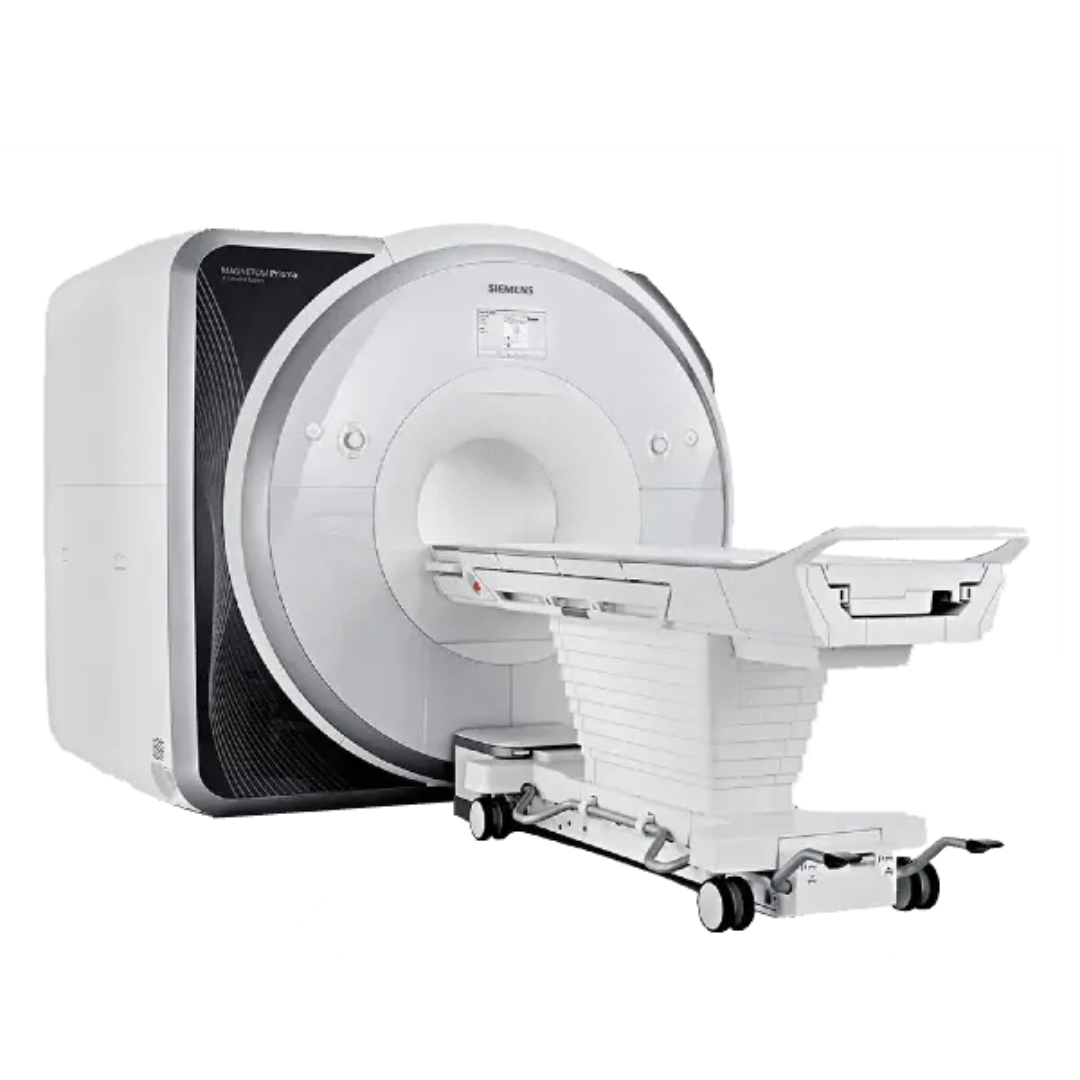
Description
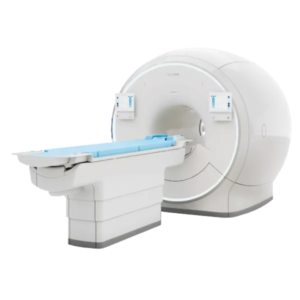
The Siemens MAGNETOM Prisma 3.0T is widely recognized as the gold standard in high-field 3.0-Tesla MRI for advanced clinical applications and neuroscience research. Developed to push the physical boundaries of magnetic resonance, the Prisma combines powerful gradient electronics with Siemens’ most sophisticated RF transmit and receive architecture. Designed in a focused $60\text{ cm}$ bore configuration, the system maximizes gradient efficiency and magnetic field homogeneity to produce extraordinary spatial and temporal resolution.
At the heart of the MAGNETOM Prisma is the XR 80/200 gradient engine, which achieves a maximum gradient amplitude of $80\text{ mT/m}$ simultaneously with a slew rate of $200\text{ T/m/s}$ on all axes at a full $100\%$ duty cycle. Paired with Tim 4G DirectRF technology (supporting up to 128 independent RF receive channels) and optional Parallel Transmit (pTx) body/head coils, the Prisma suppresses $B_1$ field inhomogeneities, shortens acquisition times via SMS (Simultaneous Multi-Slice) acceleration, and enables microscopic structural and functional imaging of the human brain, heart, and musculoskeletal system.
Key Features & Advanced Technologies
-
XR 80/200 High-Output Gradient System: Unrivaled $80\text{ mT/m}$ amplitude at $200\text{ T/m/s}$ slew rate per axis allows ultra-short echo spacing, reduced diffusion distortion, ultra-high $b$-value acquisition ($b > 3000\text{ s/mm}^2$), and crisp microscopic resolution.
-
100% Gradient Duty Cycle: Engineered with advanced force-balanced gradient coils and dedicated cooling systems to maintain full performance continuously during intense, prolonged scan sequences (e.g., fMRI or HARDI series) without thermal derating.
-
Tim 4G Architecture & DirectRF: Up to 128 independent receive channels with up to 204 integrated matrix coil elements. Digitizes signals directly inside the coil housing to achieve ultra-high Signal-to-Noise Ratio (SNR) and unprecedented parallel imaging acceleration factor capabilities.
-
Parallel Transmit (pTx) & TimTX TrueForm: Eliminates dielectric shading and RF heating artifacts at 3.0T through multi-channel RF transmit shaping ($B_1$ shimming), ensuring uniform contrast across large field-of-view body and cardiac studies.
-
Simultaneous Multi-Slice (SMS) Acceleration: Enables simultaneous excitation and readout of multiple brain slices, reducing fMRI and DTI scan times by up to $68\%$ while preserving spatial resolution and signal fidelity.
-
DotGO Engine & syngo MR Software Suite: Streamlines complex research and clinical protocols with automated slice positioning, standard protocol execution, and precise repositioning for longitudinal patient studies.
Technical Specifications
| Parameter | Specification |
| Field Strength | $3.0\text{ Tesla}$ Superconducting |
| Gantry Bore Diameter | $60\text{ cm}$ High-Homogeneity Closed Bore |
| System Length (Cover-to-Cover) | $213\text{ cm}$ Total Length |
| Max Field of View (FOV) | Up to $50\text{ cm} \times 50\text{ cm} \times 50\text{ cm}$ |
| Gradient System (XR Engine) | $80\text{ mT/m}$ Peak Amplitude / $200\text{ T/m/s}$ Slew Rate (Simultaneous) |
| Gradient Duty Cycle | $100\%$ Full-Duty Cycle (Force-Balanced Design) |
| RF Receive Channels | Configurable: 64 or 128 Independent DirectRF Channels |
| RF Transmit Architecture | TimTX TrueForm with optional 2-Channel Parallel Transmit (pTx) |
| Coil Matrix Elements | Up to 204 Integrated Tim 4G Matrix Elements |
| Patient Table Weight Limit | $200\text{ kg} \text{–} 250\text{ kg}$ ($440\text{–}550\text{ lbs}$) |
| Helium System | Zero Helium Boil-Off Technology |
Reviews
There are no reviews yet.